5/30/26
Well, my youngest made it across the finish line last night — graduating from high school with a lot of honors and smiles and pride. His class navigated middle school during the pandemic, and I think we — as a society — often ponder what effect that may have had on them, and the impact for them down the road. But as one of his fellow students said last night, it made them resilient, and that was surely on display.
In line with that, author Nat Cassidy mused yesterday: “Just a weeeee bit poignant how Gen Z filmmakers are making horror movies about being trapped in unremitting loops of uncanny hell, where prospects of love and career and reward of any kind are revealed to be glitching simulacra of inescapable menace, like modern life is a dead mall full of hollow doppelgängers. Gosh can’t imagine why that’s striking a chord so quickly with so many viewers in 2026.”
I would also point out that as a whole, my son’s class trend toward times that occurred before the one we’re in now. The class song was “Iris” by The Goo Goo Dolls. The choral selection for their graduation ceremony was a song by the Beatles. Before we left for graduation, I helped my son fix his stereo, which consists of a receiver, double tape deck, CD player, and speakers all from the 1970s and 1980s. To test it afterward, we used his Cheap Trick Dream Police cassette. Above his stereo hangs a vintage concert poster for Pink Floyd.
I didn’t see his classmates using their phones after the ceremony or taking lots of selfies. The people doing that were their Millennial and Gen-X parents and Gen-X and Boomer grandparents.
The kids, I think, are alright. Or they will be, as they head out into the world.
~
Women In Horror Year: Day 47
The Box Jumper by Lisa Mannetti
MAGIC, MYSTERY, AND ILLUSION: HOUDINI'S BATTLE WITH SPIRITUALISTS
In Lisa Mannetti’s wonderfully disturbing novella, THE BOX JUMPER, we meet Leona Derwatt, Houdini’s assistant on and off stage, and one of his mistresses. Houdini not only takes her into his confidence, teaching her the intricacies of his magic, but teams with her as they confront and expose fraudulent psychics and mediums of their day. The tension in the story (based on Mannetti’s thorough research) involves Houdini’s conflicts with fake mediums (who may have been complicit in his death) and Leona’s continued run-ins with the same phony psychics later in her life
My favorite memory of Lisa Mannetti involves a wild night in Portland, Oregon. This was a decade and some change ago, a few years before Portland became more permissive or anarchic (depending on your socio-political point of view). Jeff Burk, my then-editor at Deadite Press, took myself, John Urbancik, and Michael T. Huyck to a place called The Lovecraft Bar. The bartender, upon discovering that I was the guy who wrote the EARTHWORM GODS trilogy, decreed that my friends and I were drinking for free that night.
And oh my god, did we.
When last call came, Jeff headed home to his apartment. We had walked to the bar from our hotel, and getting back there proved to be a problem. Uber and ride shares hadn’t yet been invented, and there was no app for guiding your drunk ass friends safely back to where you needed to go. We were reliant on either our feet or a taxi. The problem with that was Mikey’s feet no longer worked, and the cabs refused to take us. Mikey sat down on a curb, proclaimed that he couldn’t walk again until the planet stopped spinning, and then lay back, giggling, and gazed at the night sky. John sat down next to him and then found out that his feet no longer wanted to work either.
I managed to get a cab to stop, but the driver refused to take us, citing a law that said he couldn’t transport clearly inebriated passengers. “But I’m fine,” I insisted. “And they’ll be fine, too.” He looked at me as if my definition of fine and his were two diametrically opposite things, and drove away.
Then a cop car slowed and stopped, and an officer very helpfully told me that he was going to circle the block and if we were still there when he came back, there would be trouble.
I stood there, frustrated and weighing my zero options. John giggled and elbowed Mikey and said, “Usually it’s Keene causing the trouble. Tonight it’s us.” And then Mikey joined in the giggling and cheerfully yelled, “Yeah, Peachy! The tables have turned!”
It was at this point that Mikey decided laying down in the road was better. Then John slid into the road and joined him.

Mikey Huyck decides the road will make a fine place to sleep.

John Urbancik decides the road can also serve as a chair.
I continued to stand there, now weighing whether or not I had enough conscience left in me to feel bad about abandoning the two of them, when suddenly, out of the darkness, like a legit goddamn angel, walks Lisa Mannetti — five feet of smiles and grace. I quickly explain the situation, and she calmly calls John Palisano, who then shows up and carries Mikey on his back, while Lisa charms John into getting up and following her by talking to him, but always staying two steps ahead and just out of earshot, so that he has to keep walking to carry on the conversation.
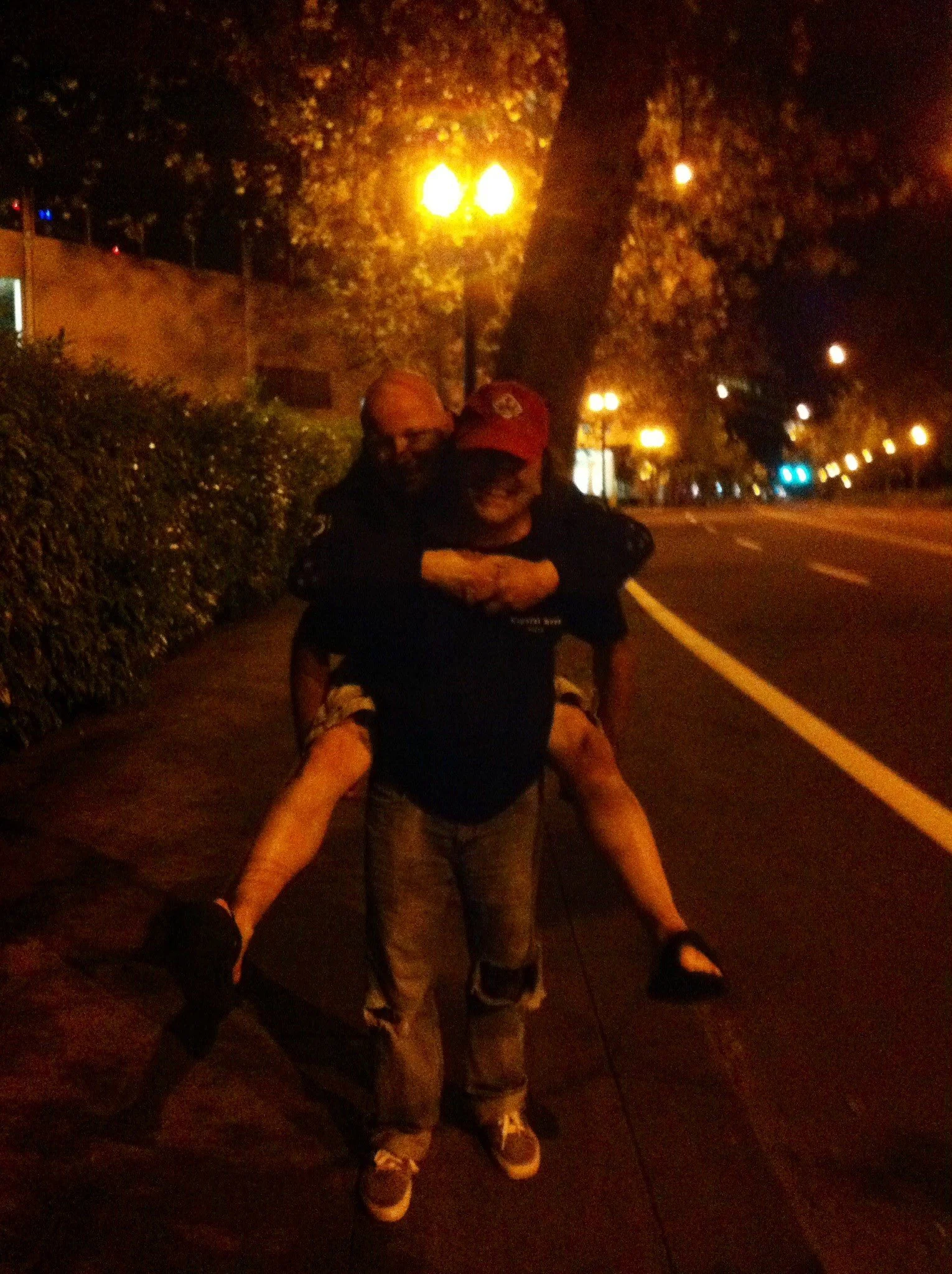
John Palisano serving as Mikey’s transport.
And that worked for several blocks until Palisano’s back gave out. At which point Lisa flags down the next taxi, leans in close to the guys window, and quietly talks to him. To this day, I don’t know what she said, but she charmed the fuck out of that cabbie, and next thing I know, all five of us are piled into the back and he takes us to our hotel.
I thanked Lisa profusely when we arrived safely. Grinning, she said, “I got to fix something for Horror’s fixer. That was awesome!”
And that was Lisa.
The Box Jumper is a wonderful work of historic horror fiction — exhaustively researched and painstakingly detailed. She worked on this novella for years, making sure she got everything right — the historic events, the vernacular and attire of the time, etc. And the result is wonderful, because the reader feels like they’ve been transported. More importantly, Houdini and the other characters feel real, as well. Yes, it’s a fictional portrayal of him, but it doesn’t feel that way. There’s a lot of Lisa in the main character of Leona. She’s the type of protagonist who could summon another writer to come carry a drunken editor, and qiuetly charm a cab driver into doing the unthinkable.
Lisa Mannetti left us way too early, and she is missed. But writers have a curious form of immortality, in that a part of us lives on as long as someone is still reading us. Honor her today by reading The Box Jumper. Available in paperback, eBook, and audiobook from Smart Rhino Publications.