5/29/26
New episode of Keeneversations went live last night.
The Artist Formerly Known As Dungeonmaster 77.1 - Keeneversations - Ep 46
The Horror Show with Brian Keene's "Dungeonmaster 77.1" joins us to discuss his writing journey, why he decided to follow Joe Hill's career path, his desire to not be seen as a nepo-baby, and what he learned growing up around writers and artists such as Paul Tremblay, John Urbancik, Kasey Lansdale, Stephen Kozeniewski, Wile E. Young, and Christian Jensen, as well as his father and stepmother.
And another episode is now free and out from behind the paywall.
Awards and Rewards - Keeneversations - Ep 43
A combination of Daniel Kraus's Pulitzer Prize win and a conversation with a dejected author lead Brian and Mary to discuss literary awards and nominations, and how they impact a writer's career. Is it really an honor just to be nominated? Did Brian really once try to pawn a Bram Stoker Award statue? Is there a difference between being recognized by your peers versus your readers?The answer to these questions and more, in this episode.
All episodes are available on Patreon, Spotify, and right here on the website you are currently reading (just click that Keeneversations tab at the top, or, if you are reading this on a mobile phone, in the dropdown box).
~
In 2002, an intervention was held. Participants included authors J.F. Gonzalez, Mary SanGiovanni, Tom Piccirilli, Weston Ochse, John Urbancik, Regina Garza Mitchell, Maurice Broaddus, Ryan Harding, Rain Graves, Wrath James White, Tim Lebbon, Carlton Mellick III, Geoff Cooper, Mike Oliveri, and Michael T. Huyck Jr. The target of the intervention was myself, and the reason for the intervention was my wanton disregard for the proper use of semicolons. And it’s true. I abused the hell out of semicolons. My friends insisted that going forward, any time I felt the urge to use a semicolon, I should use an em dash instead.
So, I did.
Three decades later, when my work was hoovered up without my permission by a number of various tech companies to train their generative A.I., the one thing all of the various bots had in common was the use of em dashes. Since then, well-meaning but ill-informed people have said that em dashes are a sure sign that something was written by A.I.. That is not true. Em dashes are simply a sign that the A.I. was trained on my books.
All joking around aside, though — em dashes are not a sign that A.I. wrote something. Nor is the “rule of three”. Lots of human authors do one or both of those things. Those of you attacking authors because you are certain those two things indicate generative AI? Your heart may be in the right place, but you are doing more harm than good.
Those A.I. detectors don’t work, either. Jeff Strand recently experimented with one who insisted his novel was written by A.I. (it was not, of course).
The best way to tell human writing from gen-A.I. writing is to read. Read a lot of books that you know were written by human beings. Books published before 2020, perhaps. Raise your reading level. Then, when you get to something that’s been spat out by a bot, you’ll know it. It’s glaringly obvious. You’ll see math, rather than human emotion and imagination, in the structure. Machines create product. Humans create art. Sometimes that art might be uplifting or elevating. Sometimes it may just be entertainment. But product? Product is just that, and the more you read, the more you’ll recognize it.
~
Women In Horror Year: Day 46
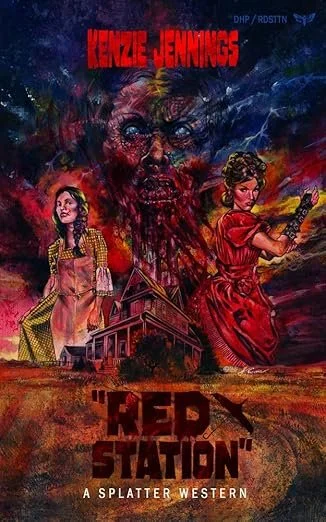
Red Station by Kenzie Jennings
A refuge for the weary becomes a beacon for the lost in this violent Splatter Western.
Four stagecoach passengers seek shelter at a remote home station: a doctor searching for a missing family, a newlywed couple heading to their homestead, and a lady in red harboring secrets. As a storm rages outside, they discover their haven is a den of blood and bones, where survival demands more than just courage.
Their night at the Station has only just begun, and revenge is a dish best served scalding hot. For fans of dark Westerns, gory horror, and supernatural suspense, Red Station delivers a thrilling ride into the heart of darkness.
So immersive and authorative is Kenzie Jennings’ view of America’s Old West that, if I didn’t know any better, I’d say she was a professor who specialized in that time period. (She is indeed a professor, but not of cowboys and stagecoaches). Red Station feels very authentic, regardless, and it’s in no rush for the beginning half, building slowly, giving the characters time to breathe and develop, and giving the reader time to empathize with them even more. Then, and only then, does the Splatterpunk kick in, and when it does, it is absolutely merciless. Top it off with electric dialogue, vivid, descriptive imagery, and some masterful storytelling, and this is one of the best weird westerns of the last decade. Red Station is available in paperback, eBook, and audiobook from Dead Sky Publishing.