8/7/26
Mary will be home tomorrow (we hope). Was doing the math this morning, while I watched the sunrise and the fog battle it out over the river (the sunrise won) and I think it’s been three weeks since we saw each other? But time moves strangely this summer, and everything is flattening and spreading, so I can’t be sure.
Having a mini-existential crisis with my coffee this morning. I used to believe that writing was its own form of immortality — that our books lived on long after we were gone. But I no longer believe that to be true. For every Charles Dickens, Shirley Jackson, Mark Twain, Frederick Douglass, Leo Tolstoy, or Edgar Allan Poe still read today, there are hundreds of their friends and peers who are forgotten or out of print. Our own genre is not immune to this, nor does being forgotten apply only to those who have been dead for a long time. Richard Laymon, Jack Ketchum, Graham Joyce, and Brian Lumley were giants in this field — gone only within the last 30 years, collectively — and yet, despite still being in print, their work is already falling by the wayside. The same can be said of “writer’s writers” such as Charlee Jacob, d.g.k. goldberg, and Tom Piccirilli. For every new author or young reader who approaches me at a con to ask about what Pic was like as a person (one of the kindest souls I’ve ever known) or tell me what an impact Charlee’s work had on them (she was uniquely gifted, wasn’t she) there are a hundred others who’ve never read them. It even applies to those still living — an entire generation of writers who, from 1999-ish until around 2012-ish, rebuilt this entire genre from the absolute ashes, kept it alive, got it back into the spotlight, and paved the way for what is now a second golden age of horror — mostly now forgotten or unknown or unread.
But I suppose that’s the downside to living in a second golden age of horror — there’s so much remarkable work being published by so many remarkable authors, and a new generation of horror readers are going to naturally gravitate toward a new generation of horror writers because it is those writers who speak to them. It can leave folks my age or older feeling forgotten. And I think that’s why we see the occasional flame out or lashing out. It comes from that place of feeling forgotten. That doesn’t excuse it. No. But it does explain it. It’s driven by fear, and the unwelcome revelation that success in this field — any level of success — is ultimately fleeting, except for a very hallowed few, and we won’t know if we are one of those few until long after we are dead (as it happened for Lovecraft and Robert E. Howard).
Now, you may think, “Well, you’ve had an amazing career, Keene. Surely you don’t feel forgotten.”
But you’d be wrong.
It is a feeling that I suspect we all struggle with, from time to time. I certainly have, the last two years or so. But I’ve also tried to make a consistent effort to stay approachable and stay involved. Maybe you haven’t read my stuff and only know of me because your favorite authors like Josh Malerman or Eric LaRocca read my stuff when they were younger. Or maybe it was your parents who listened to The Horror Show with Brian Keene and you’re more of a Talking Scared fan. But it is my hope that you know, “That guy used to be somebody, and he seems pretty approachable. Maybe he has some advice during this quiet moment at the convention.” Because I do, and I’m glad you asked, because I love talking shop, and I have knowledge to share.
It has been said that “Don’t You (Forget About Me)” is the quintessential song of my generation, and I suppose it’s as good a song as any to sum up Gen-X. But what once served as a soaring melodic signal of triumph as John Bender left detention for the day in The Breakfast Club becomes a haunting and melancholy meditation decades later.
But never mind all that, right? Regardless of whether or not writing offers immortality, it’s how I pay my bills, and today I need to work on me and Chris Golden’s next project, codenamed OPERATION LITTLE GOLDEN BOOK, so now that the sun has finally arisen, it’s time to have another cup of coffee and head back into the fiction mines. But before I do…
~
Women In Horror Year: Day 97
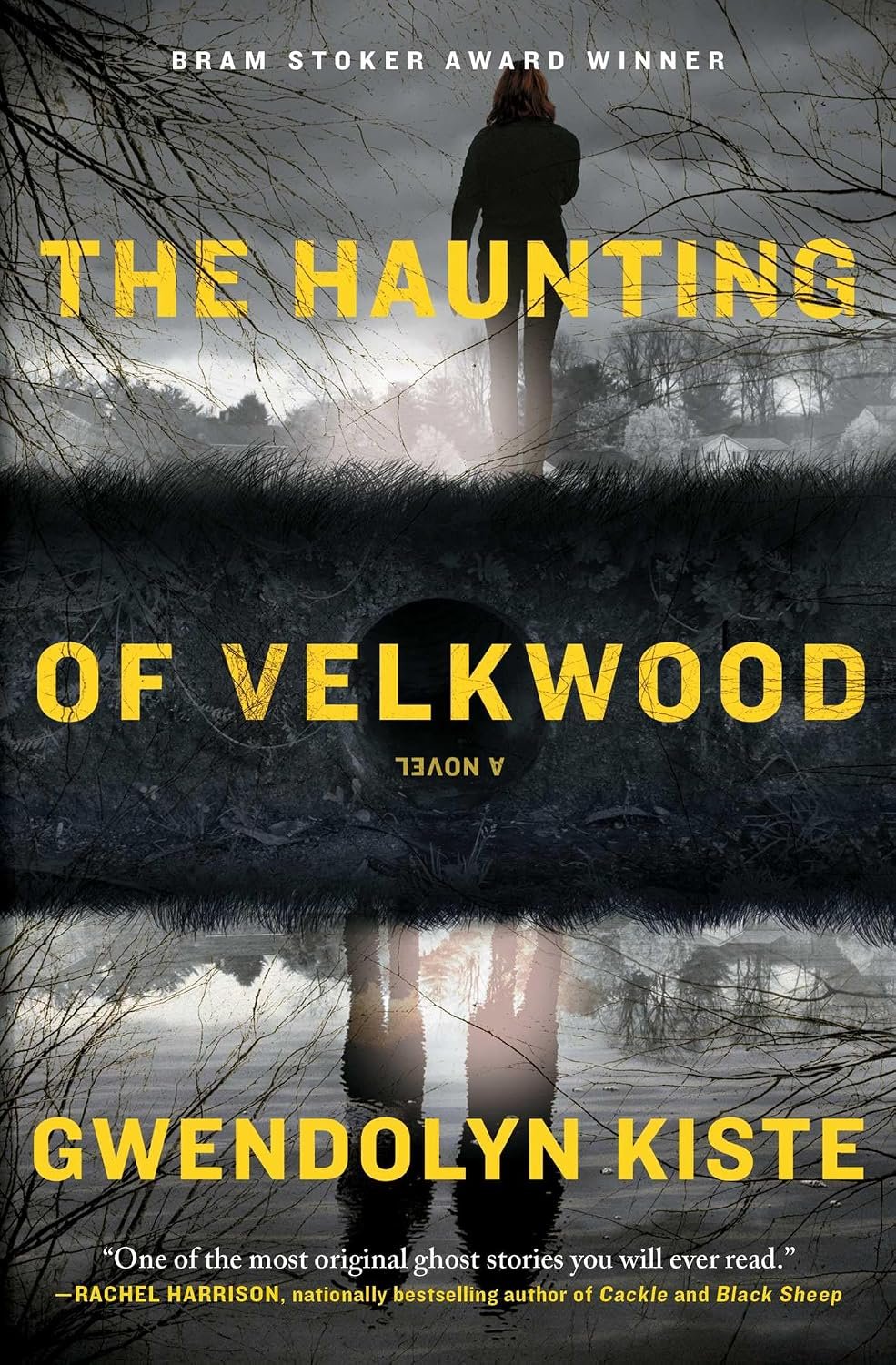
The Haunting of Velkwood by Gwendolyn Kiste
Hardcover - Paperback - eBook - Audiobook
Winner of the 2025 Bram Stoker Award for Superior Achievement in a Novel
Finalist for the 2025 Shirley Jackson Award
From Bram Stoker Award–winning author Gwendolyn Kiste comes an “emotionally devastating, character driven ghost story” (CrimeReads) about three childhood friends who miraculously survive the night everyone in their suburban hometown turned to ghosts—perfect for fans of Yellowjackets.
The Velkwood Vicinity was the topic of occult theorists, tabloid one-hour documentaries, and even some pseudo-scientific investigations as the block of homes disappeared behind a near-impenetrable veil that only three survivors could enter—and only one has in the past twenty years, until now.
Talitha Velkwood has avoided anything to do with the tragedy that took her mother and eight-year-old sister, drifting from one job to another, never settling anywhere or with anyone, feeling as trapped by her past as if she was still there in the small town she so desperately wanted to escape from. When a new researcher tracks her down and offers to pay her to come back to enter the vicinity, Talitha claims she’s just doing it for the money. Of all the crackpot theories over the years, no one has discovered what happened the night Talitha, her estranged, former best friend Brett, and Grace, escaped their homes twenty years ago. Will she finally get the answers she’s been looking for all these years, or is this just another dead end?
Award-winning author Gwendolyn Kiste has created an “eerie and evocative” (Kirkus Reviews) suburban ghost story about a small town that trapped three young women who must confront the past if they’re going to have a future.
I have to imagine that it took Gwendolyn Kiste a long time to write and edit The Haunting of Velkwood, simply because this transcendent puzzle box of a novel is so meticulously perfect. It takes the themes found in works like the Silent Hill franchise, Mary SanGiovanni’s Thrall, and Stephen Kozeniewski and Wile E. Young’s The Perfectly Fine House and cleverly inverts them — a sort of supernatural version of Jeff Vandermeer’s Southern Reach, but done with grief horror and ghosts rather than science fiction trappings and tropes. If it didn’t take her a long time to write this, then we must all band together and stop her or we’ll all soon be out of a job. ;-)
Because… sweet Jesus and baby Cthulhu, this is a masterclass of modern supernatural horror.
The setting — a suburban cul-de-sac — feels as real as the characters, and those characters — three young woman who escaped a supernatural disaster that claimed their neighborhood and loved ones — are some of the most well-drawn and believable horror fiction characters in recent memory. As we talked about in yesterday’s review of Gemma Amor’s Happy Hour, horror is most effective if there is empathy between the reader and the characters. It’s the difference between Laurie Strode in Halloween and the random surplus teenagers Jason carves up in Friday the 13th. Gwendolyn takes her time with these girls, letting them breathe and emerge fully formed, with twenty years of trauma shaping and molding them, and the result makes for some heavy emotional stakes. When Talitha and Brett drive away at the end, I couldn’t help but raise one fost and exclaim “Fuck yeah!” before closing the book.
The Haunting of Velkwood is available in hardcover, paperback, eBook, and audiobook from Saga Press.