8/20/26
If your social media and Discord channels are full of horror writers talking about the most recent HWA (Horror Writers Association) scandal, you might be forgiven for any confusion as to which particular scandal at the moment, because there are multiple, including the fact that — with an election only a few weeks away — the only Presidential candidate (who was running unopposed) has stepped down after some allegations were made online.
(I made a joke online last night about launching a write-in campaign, and was instantly terrified by the number of people who actually wanted me to do it. Folks, I stopped THE HORROR SHOW WITH BRIAN KEENE during the height of its popularity because of the toll dealing with crap like this was taking on me, and on my writing. There’s no way in hell I’d ever put myself back in that position as a President. And besides that, I’m not even a member anymore. To put a finer point on it, both my wife and John Urbancik are threatening to hunt down anyone who convinces me to throw my hat in the ring, and you don’t want that, because Mary will punch you and John will read poetry at you).
The HWA has always been a source for controversy. When I first joined, back in the late-1990s, there were allegations of officers tampering with the Bram Stoker Awards tallies and misuse of membership dues. Not to mention that Edward Kramer — who would go on to be Horror fiction’s very own cross between Jeffrey Epstein and Jared from Subway — was Vice-President. And yes, you can argue that his term was before his crimes became public, but there were plenty of people who knew, because those of us just starting out were told about it privately by John Pelan, Ray Garton, and other folks who thought Kramer should be run over by a garbage truck. There was enough smoke around that fire that many of us newbies quit.
We didn’t rejoin until Richard Laymon became President, and we rejoined because he asked us to, and asked us to help him fix the organization. The HWA repaid him with enough stress and pressure that he had a massive heart attack while in the midst of working on HWA stuff, so all of us quit again. Many never went back. I did, a few times, because I thought I could fix things — most recently as a Trustee. I didn’t even make it a full term before dropping out because of concerns I had over AI. I didn’t renew my membership, and when I attended StokerCon earlier this year, I did so without a ticket or membership to that, either. You don’t need either of those things to see folks and network at the event, or to access to the hotel bar and the lobby and various meeting areas. The only thing a ticket gets you is access to the readings and panels and a plate of dry chicken cordon bleu the awards banquet.
Anyway, the latest of all the latest HWA controversies is that Brett Talley, a horror writer who served as Deputy Assistant Attorney General in the Department of Justice, and who was nominated by Donald Trump to the United States District Court for the Middle District of Alabama in 2017 (he later withdrew from nomination after several controversies), was revealed to be the person in charge of HWA’s Grievance Committee. That’s an important position. If you, as a dues paying HWA member, have a grievance — let’s say a publisher ripped you off or a fellow author slipped you a roofie and had their way with you at an official event — and you file a confidential report, then Talley is the person in charge of handling that information and acting upon it. The controversy surrounding this stems from three things: 1) Talley’s only the third judicial nominee since 1989 to receive a unanimous rating of Not Qualified from the American Bar Association, and 2) Talley appears (according to Buzzfeed, Slate, and other media venues) to have made comments in which he showed support for Nathan Bedford Forrest and “The early KKK”, and falsely claimed that during reconstruction, the KKK did not engage in violence or racism, and also allegedly supported a 20-year old having sex with a 14-year old, and 3) some among the dues paying membership state they were not aware of his position inside the organization.
You can probably understand why a writer of color or an LGBTQ+ author might have concerns about filing a private concern with him. To the best of my knowledge, Talley has not clarified or apologized for these past comments.
Personally, I think the value of groups like HWA, SFWA, RWA, etc have passed. I’m hard pressed to think of anything one can get from such organizations that they can’t get elsewhere, save for the local chapter element. Looking for submission calls and publisher guidelines and agents open to queries? The internet is a thing that exists. Interested in a weekend of panels and programming geared toward writing and publishing at all levels? Scares That Care’s AuthorCon, Camp Necon, KillerCon, GenCon’s Writer’s Symposium, and a host of other such events exist (and are less expensive). Mentoring? Go to one of those, and show that you’re sincere, and you’ll find a mentor — and apparently faster than you will as an org member, according to many anecdotes.
Yes, there is an immediate sense of community that comes from the local chapters, but what’s to stop the local chapters from splintering away from the HWA and becoming their own thing. Jacob Haddon and I did something like that back in the early-2000s with the Mid-Atlantic Horror Writers. Maurice Broaddus did it with the Indiana Horror Writers.
Community is where and what you make it. You don’t need the backing of an official umbrella organization to make it so.
How to fix HWA (or SFWA or RWA for that matter)? I don’t believe you can, at this point. I believe the healthiest thing to do for the industry and all involved is to let them go the way of dial-up modems and AOL CD-Roms. It attracts only two kinds of volunteers — 1) talented writers who truly mean well and want to be agents of change (like the aforementioned Dick Laymon or current President L. Marie Wood), whos writing careers and personal lives invariably suffer due to their involvement, or 2) social climbers who are more interested in being popular or having power than they are being writers (you can go ahead and fill in the names for this one).
I would be very interested in seeing some younger folks launch a new sort of organization, and would offer my advice and insight to any such endeavor, along with a list of cautionary things to avoid. But it would have to be a different animal, offering different things. It would have to get back to the core of what HWA initially was when it was founded.
Those are just my thoughts. As author Geoff Cooper, (who quit HWA after Dick Laymon’s death and never rejoined) often says, your mileage may vary. But with an election only weeks away and the organization in state of seemingly perpetual chaos, it is understandable how an observer might think it dead in the water…
~
Women In Horror Year: Day 107
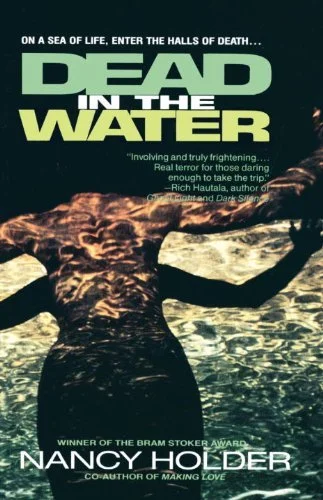
Dead In The Water by Nancy Holder
From Bram Stoker Award–winning author Nancy Holder comes a chilling novel of horror on the sea. This is how it will be when you drown. . . .
At a sun-washed dock in Long Beach, California, the creaky freighter, Morris, loaded with brightly colored boxcars, takes on passengers. Among the vacationers: a disgruntled yuppie couple, a child stricken by cancer, a woman searching for her lost husband, and a female cop packing a .38 and bitter memories of a boy who drowned before her eyes.
In seas of love and blood they will drown, one at a time. And for their company, they will have those who have drowned before them—and those who have received a message in a bottle. . . .
Yesterday in this space, we looked at Melanie Tem’s seminal debut novel Prodigal, one of the early books in the now legendary Dell/Abyss paperback line. Today, I want to jump forward a few years to one of the latter books to be published by Dell/Abyss before the mid-90s horror implosion — Dead In The Water by Nancy Holder. It plays with the (then) underused trope of the ghost ship, but in a much more modern setting, and with a harrowing sensibility that one would expect from something by Jack Ketchum or Charlee Jacob. It’s not quite Extreme Horror or Splatterpunk, but it skirts their edges, and it does have that same jarring emotional resonance that the best Splatterpunk often delivers. If you want a comparison, it’s akin to Gemma Amor’s more recent works, or the horror novels of Sarah Pinborough from a decade and a half ago. Nancy takes time introducing the characters and building empathy with them for the reader. That’s a tough trick, given the size of the cast, but she pulls it off masterfully, particularly with a child suffering from cancer, and a haunted cop who can’t escape her demons.
Earning accolades at the time from such luminaries as Poppy Z. Brite, Brian Lumley, and Rock Hautala, Dead In The Water is a fine example of 1990s horror fiction, particularly the finale, which veers almost fully into Bizarro territory, and solidifies its place among the Dell/Abyss line-up. The cover to the mass-market paperback was iconic, and it’s nice to see that it is still being used on the more recent editions.
Dead In The Water is available in paperback and eBook from Penguin Random House.
A reminder that you can peruse all of the previous Women In Horror Year entries via this handy index.