7/3/26
Muggsy Parker Schow — beloved by directors, writers, actors, FX people, readers, and fans — is tumor free! You can read the full update on the GoFundMe.
~
Women In Horror Year: Day 72
Bisclavret by Marie de France
I’m dispensing with the publisher’s synopsis today and getting right into it, because our topic is 12th Century Feminist Werewolf Fiction, and no marketing copy put together by someone in the marketing department is ever going to accurately convey that.
The supernatural informed much of humankind’s early written works, from the various texts of the world’s religions to cultural folklore and myths to fiction. Eventually, one religion began to influence them all. Around the same time an anonymous writer was penning Beowulf, the Roman Catholic church’s first official accusation of real-life Satanism took place in the French city of Toulouse. Indeed, after Rome’s Edict of Milan, Christianity spread throughout Europe, the Middle East, and North Africa. As it expanded, it came into contact with the religions and writings of other cultures, which the church regarded as pagan. The pagan deities were then converted to Christian demons, and the fauns, satyrs, and other supernatural monsters we’ve discussed in previous chapters were matched with characters from Christian iconography that had similar physical traits. Thus, Satan was now more likely to be depicted as the great god Pan, complete with horns and cloven hooves, than he was the serpent from the Bible’s Genesis or The Epic of Gilgamesh.
But Christianity wasn’t the only thing influencing supernatural fiction, and by the twelfth century, horror writers were using another monster to depict a very specific human fear — one that all women have felt at one time in their life, from the days of ancient Rome to Harvey Weinstein’s casting couch in 2017. It’s a fear that transcends religion, race, class, and financial status. And in an era when our civilization seems more divided by our political differences than ever before, it’s a fear transcends those, as well. Conservative, Progressive, or Middle-Of-The-Road — it’s not politically controversial to acknowledge the unfortunate truth that some men have treated women abhorrently throughout humankind’s existence.
They have.
At some point in their lives, most women have had to ask themselves, “Am I comfortable being left alone with this particular man? Can I trust him?”
That’s a very particular kind of fear.
And in the twelfth century, several female horror writers symbolized that fear via another supernatural creature of old — the werewolf.
Marie de France was the first female French poet. In 1911, scholar Eugene Mason wrote, “An age so feminist in its sympathies as ours should be attracted the more easily to Marie de France, because she was both an artist and a woman. To deliver oneself through any medium is always difficult. For a woman of the Middle Ages to express herself publicly by any means whatever was almost impossible.”
Proficient in many languages, including Latin, English, and Breton, Francien (with some Anglo-Norman influence), she is known to have translated many Greek and Roman myths, Aesop’s Fables, and more. One of her most notable translations are her twelve Breton lais. Lais were rhymes sung by minstrels. Marie de France then translated these into written poems. One of them was a werewolf story called “Bisclavret”. The story concerns a baron in Brittany who has a terrible secret that he refuses to share with his wife. Every week, he vanishes for three full days. Distraught, his wife begs him to tell her the truth. The baron reveals that he is a werewolf. His wife is shocked by the revelation that there is a hidden beast lurking inside of this man she loved.
“Bisclavret” went on to influence other werewolf fiction. It was translated into Old Norse, and eventually Icelandic as the Tiodels saga, reworked twice more in French as “Biclarel” and Melion, the latter of which clearly influenced in Sir Thomas Malory’s King Arthur epic Le Morte d’Arthur. Modern day reworkings and adaptations include The Wolf Hunt by Gillian Bradshaw, The Tattooed Wolf by K. Bannerman, and This Is Not A Werewolf Story by Sandra Evans.
Guillaume de Palerme is another werewolf story from the twelfth century. Commissioned by the Countess Yolande, the daughter of Count Baldwin IV, it tells the story of Guillaume, a commoner who falls in love with Melior, the daughter of a Roman emperor. Luckily for Guillaume, Melior loves him back. There’s just one problem—she has been promised to a Greek prince. The two lovers escape together into the forest and disguise themselves in bear skins. Meanwhile, Guillaume’s cousin, Alfonso, has been turned into a wolf by his evil stepmother. He also flees into the forest and encounters the lovestruck fugitives. Alfonso, in wolf form, protects them from the dangers of the forest and catches food for them. Eventually, they all live happily ever after. Guillaume and Melior get married, and Alfonso is changed back into a human again. I didn’t include links above because, to the best of my knowledge, there’s no English translation currently in print.
It is interesting to note that all of the werewolf stories cited above not only depict the struggle of good versus evil, like all horror fiction, but also symbolize the conflict between the doctrine of the Christian church and a rapidly changing society. Even then, horror fiction wasn’t just depicting the fears of the times, but making them safe for the public and challenging convention and accepted mores.
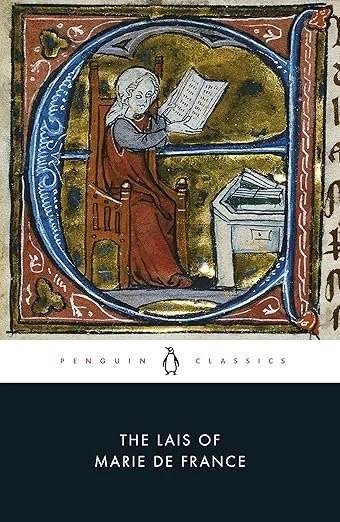
Bisclavret is included in this Penguin Classic collection of Marie de France’s work, available in paperback, eBook, and audiobook.